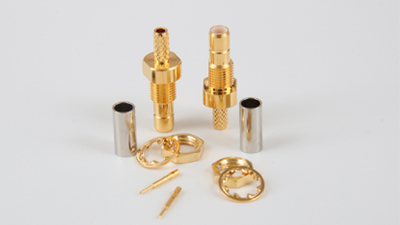
The evolution of RF coaxial connectors is primarily driven by the following key trends:
1. Miniaturization
As electronic systems become more compact, RF connectors continue to shrink in size. Examples include ultra-small form factors like SSMB and MMCX series, designed for space-constrained applications.
2. Higher Frequency Support
The push toward higher frequencies is accelerating. While U.S.-made connectors (e.g., HP's 110GHz models) lead the market, domestic products now reliably operate beyond 40GHz.
3. Multifunctional Integration
Modern RF connectors no longer serve merely as interconnects but also integrate signal-processing capabilities such as: filtering, phase tuning, frequency mixing, attenuation, detection, limiting and so on
4. Low VSWR & Low Loss
Precision measurement applications demand VSWR <1.1 and insertion loss <0.05dB to ensure signal integrity and measurement accuracy.
5. High Power/Capacity
To support data highways, next-gen connectors are engineered for:
6. Advanced SMT Compatibility
Surface-mount technology (SMT) innovations enable:
Simplified multilayer PCB routing
Automated assembly for high-volume production
Thermal-optimized designs for reflow soldering
Allen Chen
Hi, I’m the founder & managing director of Baierde Electronic, Allen Chen, an expert in RF coaxial connectors, and I Initiated the current business venture in 2009.
Over 20 years of expertise in RF coaxial connectors, with hands-on proficiency spanning design, development, and high-volume manufacturing.
Leading high-performance teams to deliver 16 years of unbroken revenue growth, achieving $6+ million sales via strategic product positioning, optimized supply chains, disciplined cost management, and uncompromising quality standards.