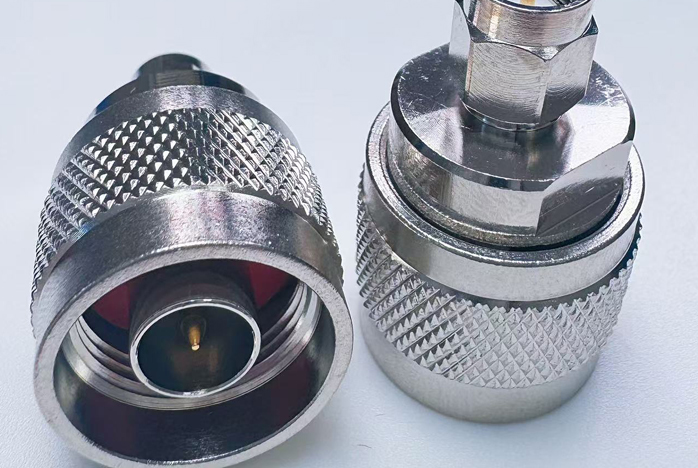
RF coaxial adapters are critical components in high-frequency systems, enabling seamless connectivity between different connector types while maintaining signal integrity.
RF coaxial adapters enable critical signal management across industries with these core functions:
Signal Transmission: Provide stable, low-loss connections between devices/systems to ensure the signal quality and stability.
Frequency Adaptation: Facilitate frequency conversion for multi-band systems (e.g., 4G/5G coexistence)
Signal Conditioning: Integrated designs support amplification/attenuation
Interface Compatibility: Cross-connect major connector types (SMA/N/BNC) with 50Ω/75Ω impedance options
Compact Design: small size and light weight, easy to carry and use.
They are widely used in:
Telecommunications – Adapters (e.g., SMA-to-N, 2.92mm-to-3.5mm) facilitate signal routing in 5G base stations and fiber-optic networks, ensuring low PIM and stable VSWR.
Aerospace & Defense – Phase-matched adapter sets support phased-array radar and satellite communications, while hermetic designs withstand extreme temperatures (-65°C to +165°C).
Test & Measurement – Precision adapters ensure accurate calibration of VNAs and spectrum analyzers up to 67GHz, minimizing insertion loss.
Medical & Industrial – EMI-shielded adapters connect monitoring equipment and robotics, with stainless steel bodies for sterilization compatibility.
Automotive – FAKRA-to-SMA adapters enable RF signal distribution in ADAS and infotainment systems.
Broad Compatibility
SMA adapters enable seamless connections between different connector types (N, MCX, SMP, BNC, TNC etc.) while maintaining 50Ω impedance for signal integrity across diverse RF systems.
Flexible Configuration Options
Available in multiple orientations (straight/right angle) and gender combinations, SMA adapters provide versatile interconnection solutions for complex RF system layouts.
Consistent Impedance Matching
Precision-machined dielectric materials maintain 50Ω impedance throughout connections, preventing signal reflections and ensuring optimal RF power transfer.
Maintains low-loss, high-shielding RF transmission in complex systems. Gold-plated contacts reduce resistance, air dielectric or PTFE insulation minimizes loss, and full-metal shielding for EMI suppression.
Seamlessly connects different RF coaxial connector series (e.g., SMA-to-N, BNC-to-TNC, MCX-to-SMP) to resolve device interface mismatches. Different interfaces (screw coupling, push-on coupling, bayonet type coupling) achieve mechanical compatibility and impedance-matched (50Ω/75Ω) to minimize signal reflection. Baierde's customization capabilities allow for the creation of non-standard adapters.
Stable performance in extreme conditions extends system lifespan, including corrosion-resistant materials, wide temperature range (-65 degree Celsius ~ +165 degree Celsius) and vibration-proof design. Significantly expands the application scope.
An RF adapter (or RF coaxial adapter) is a passive interconnect component that enables seamless transitions between different types of RF connectors (e.g., SMA to N-type, BNC to TNC) while maintaining signal integrity. It ensures compatibility between mismatched interfaces in communication systems, test equipment, and aerospace/defense applications.
Key characteristics of RF adapters include:
1. Broad Compatibility
Cross-interface conversion: Connects dissimilar connectors (e.g., 2.92mm to SMA, N-type to BNC).
Impedance matching: Maintains 50Ω or 75Ω consistency to minimize signal reflection
2. High-Frequency Performance
Wide bandwidth: Supports DC to 67GHz+ (mmWave adapters available)
Low insertion loss: Typically <0.1dB @6GHz (PTFE/air dielectric designs)
3. Robust Mechanical Design
Threaded/coupling mechanisms: Secure connections (e.g., 1/4-36 UNS threads for SMA).
Durable materials: Brass/stainless steel housings with gold plating (≥0.5μm).
Environmental resistance: Operates in -65°C to +165°C (MIL-STD-810G compliant).
4. Specialized Variants
Gender changers: Male-to-female or female-to-female configurations.
Phase-matched sets: ±1° tolerance for phased-array systems
Choosing the appropriate RF adapter requires careful consideration of electrical, mechanical, and environmental factors. Below is a structured guide to ensure optimal performance for your application.
Key Selection Criteria
1. Frequency Range
Low-frequency (DC–6 GHz): Standard SMA/BNC adapters
High-frequency (18–67 GHz): Precision 2.92mm/1.85mm adapters
mmWave (>67 GHz): Air-dielectric or specialty designs
2. Connector Compatibility
Match interfaces (e.g., SMA female to N-type male)
Impedance alignment: Ensure both connectors are 50Ω or 75Ω (mismatch causes signal reflection)
3. Electrical Performance
VSWR: ≤1.25 for minimal signal loss
Insertion loss: <0.1 dB @ 6 GHz (critical for high-frequency systems)
PIM (Passive Intermodulation): <-150 dBc for 5G/multi-carrier systems
4. Mechanical Durability
Threaded (SMA, N-type) vs. Push-on (SMB, MCX): Choose based on vibration/durability needs
Mating cycles: 5,000+ for high-use applications
Material: Stainless steel (harsh environments) vs. brass (cost-effective)
5. Environmental Conditions
Temperature range: Standard (-40°C to +85°C) vs. extended (-65°C to +165°C)
IP rating: IP67 for dust/water resistance
Corrosion resistance: Gold plating (>0.5µm) for humid/salty environments
A professional manufacturer of RF Coaxial Connectors with over 20 years of experience
Contact With Us:
E-mail: info@brdconnector.com
Have a Questions? Call Us:
Add:
Zhongtian North Road, Xinfeng Town, Dantu District, Zhenjiang City, Jiangsu Province, China